
After his wide-ranging talks with Modi on the second and final day of his India visit, Johnson said the new defence and security partnership will enable India to strengthen its domestic defence industry as well as help the two countries protect vital shared interests in the Indo-Pacific.

India as the G20 host has a 'unique role' to play in bringing about an end to the war in Ukraine due to its 'longstanding historical' ties to Russia, the United States has said, expressing hope to work closely with New Delhi to find a way to stop the conflict.
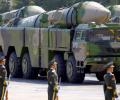
China is expanding its nuclear force and is likely to have a stockpile of about 1,500 warheads by 2035, up from the current estimated number of 400, the Pentagon has said in a report that notes that Beijing aims to expand its national power through both domestic and foreign policy initiatives.

The two sides are also expected to explore ways to deepen defence collaboration, including exercises, defence transfers and technologies ahead of the next edition of the 2+2 defence and foreign ministerial dialogue to be held in the US later this year, they said.

Describing India as an important member of the Quadrilateral Security Dialogue (the Quad) and a crucial partner for stability in the Indo-Pacific, the letter said that the lawmakers support the deepening strategic partnership between the two countries.

Ahead of the Quad summit on Friday, China said exchanges and cooperation between countries should contribute to mutual understanding rather than "targeting" a third party and refrain from "pursuing exclusive blocs".
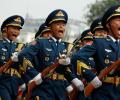
China has been an aggressor against India along the Himalayan border, a top American diplomat nominated by President Joe Biden as his next envoy to Beijing has told lawmakers, stating that the US must hold the Chinese government accountable for failing to play by the rules.

Modi will also meet Chinese President Xi on the sidelines of the summit. It would be their fourth meeting in last seven months.

In an address at the Global Dialogue Security Forum, he underlined the need for India to put greater focus on having strong bilateral, trilateral and multilateral arrangements with like-minded countries to maximise its strategic leverage in the region.

'India should not be taken by surprise if the Biden administration seeks China's cooperation at some point,' alerts Ambassador M K Bhadrakumar.

'Landed in Tokyo. Will be taking part in various programmes during this visit including the Quad Summit, meeting fellow Quad leaders, interacting with Japanese business leaders and the vibrant Indian diaspora,' Modi tweeted in both Japanese and English.

Although the Malabar is a routine exercise which has been carried out for several years now, security experts attach a lot of traction to it in view of China's assertive behaviour in the South China Sea, observes Rup Narayan Das.
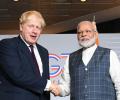
The visit, which is expected around April 22, is long overdue after Johnson was forced to cancel planned visits to India twice last year due to the COVID-19 pandemic.

China, the Ukraine crisis and Quad will dominate the discussions, observes Dr Rajaram Panda.

MEA Spokesperson Arindam Bagchi said the forthcoming Quad summit will provide an opportunity for the Quad leaders to exchange views about developments in the Indo-Pacific and contemporary global issues of mutual interest.
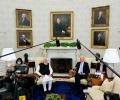
Prime Minister Narendra Modi met Joe Biden at the White House on Friday in his first bilateral meeting with the US president during which the two leaders are expected to discuss a wide range of priority issues, including combating Covid-19, climate change, economic cooperation as well as Afghanistan.

It is understood that India's border row with China figured in the talks between Foreign Secretary Harsh Vardhan Shringla and US Under Secretary of State for Political Affairs David Hale though there was no mention of it in the press statements issued by the two sides.
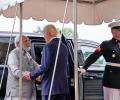
Foreign policy is always a work in progress and ups and downs are built into foreign policy process. What is permanent is national interest. Hopefully, this year, which will also witness general elections in the country, will also clear clouds in the foreign policy horizon, observes Rup Narayan Das.

According to the Biden-Harris Transition, 'the president-elect noted that he looks forward to working closely with the prime minister on shared global challenges, including containing COVID-19 and defending against future health crises, tackling the threat of climate change, launching the global economic recovery, strengthening democracy at home and abroad, and maintaining a secure and prosperous Indo-Pacific region'.

Prime Minister Narendra Modi arrived in the Japanese city of Hiroshima on Friday to attend the annual summit of the G7 grouping and the third in-person Quad leaders' meeting during which he will exchange views with world leaders on global challenges and discuss ways to collectively address them.
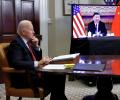
Washington is signalling to Delhi that it can rely on American support in any great game vis-a-vis China. Delhi shouldn't fall into the trap, argues Ambassador M K Bhadrakumar.
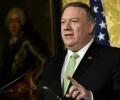
Pompeo will travel to India, Sri Lanka, Japan and South Korea from June 24 to 30. His four-nation is aimed at deepening US partnerships in the strategic Indo-Pacific region.
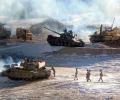
US Defence Secretary Llyod Austin described China as a pacing challenge for the United States.

'The future of BRICS is under stress as Chinese attempts to expand the platform are being resisted by India and Brazil.' 'Beijing is focused on a quick expansion with the aim of giving the platform a distinctly anti-Western orientation, which New Delhi and Brasilia seem to have no interest in,' notes Harsh V Pant.

In a post on X, Modi said, "Happy to have welcomed @POTUS @JoeBiden to 7, Lok Kalyan Marg. Our meeting was very productive."

The bilateral and Quad summits, in which Prime Minister Modi played a significant role, has sent the right message to China, observes Ambassador T P Sreenivasan.
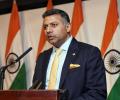
The Indian High Commissioner to the United Kingdom, Vikram Doraiswami, who was touring Scotland this week was blocked from entering a gurdwara in the capital Glasgow by pro-Khalistan extremists.
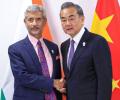
China on Friday concurred with External Affairs Minister S Jaishankar's observation that an Asian Century cannot happen if India and China don't join hands and emphasised that the two neighbouring countries have 'far more common interests than differences'.

Admiral Philips Davidson, Commander of the US Indo-Pacific Command, also told the powerful Senate Armed Services Committee on Tuesday that China's recent activities along the Line of Actual Control have opened India's eyes to what cooperative effort with others might mean for their own defensive needs as he observed that New Delhi, in the very near term, will deepen its engagement with the Quad.
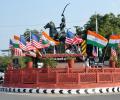
Kurt Campbell, the White House Asia Coordinator, said that in his view India is the most important bilateral relationship for the United States in the 21st century.
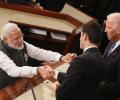
The maiden bilateral meeting between President Joe Biden and Prime Minister Narendra Modi on Friday will further strengthen the US-India strategic ties and allow the leaders to discuss the situation in Afghanistan and how the two countries can work together to fight terrorism, a senior White House official has said.

US Deputy National Security Adviser Daleep Singh also referred to the 'no limits' partnership between Moscow and Beijing and said no one believes that Russia would come running to India's defence if China breaches the Line of Actual Control.

Beijing will be intently watching Washington's response for any hint of weakness. Xi Jinping, who feels China has a limited window of strategic opportunity, will be emboldened to take additional initiatives in the Indo-Pacific and specifically against India and Taiwan, warns Jayadeva Ranade, the former senior RA&W officer and China expert.
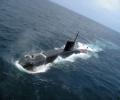
China has deployed a fleet of underwater drones called Sea Wing (Haiyi) glider in the Indian Ocean, which can operate for months on end and make observations for naval intelligence purposes, according to defence analyst HI Sutton.
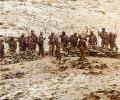
'They talk about their 2021 centenary goal, their 2035 goal, and their 2049 goal. They're accelerating. There's also been this unfortunately bashing of nationalism inside the People's Republic of China by the government'

The United States, he said, will continue to take calm and resolute steps to uphold peace and stability in the face of Beijing's ongoing efforts to undermine it, and to support Taiwan, in line with its longstanding policy.
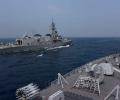
The navies of India, the US, Japan and Australia on Tuesday held a series of complex manoeuvres in the Bay of Bengal, kick-starting the four-day-long first phase of the Malabar naval exercise, seen as a prelude to future military cooperation among the member nations of the Quad or Quadrilateral Coalition.

Weeks before Canada made an explosive allegation implicating Indian officials in the killing of Sikh separatist leader Hardeep Singh Nijjar, Canadian officials sought public condemnation of the murder from their allies, including the United States, but were met with reluctance, The Washington Post reported.

Had India agreed to join the trade pact, Indian markets would have been flooded with cheap Chinese products.

EAM Jaishankar's mission is aimed at strengthening India's strategic autonomy in a complex international environment, observes Ambassador M K Bhadrakumar.
